Goli soda
Goli means marble. Sold from ice buckets on street carts for over a century, most often as lemon. Also called banta in the north and gola or kancha soda in other regions.

The marble closure began in nineteenth-century glass and now also appears in current PET packs. Here is how the mechanism works, how the format travelled and how it relates to today’s Zeros bottle.

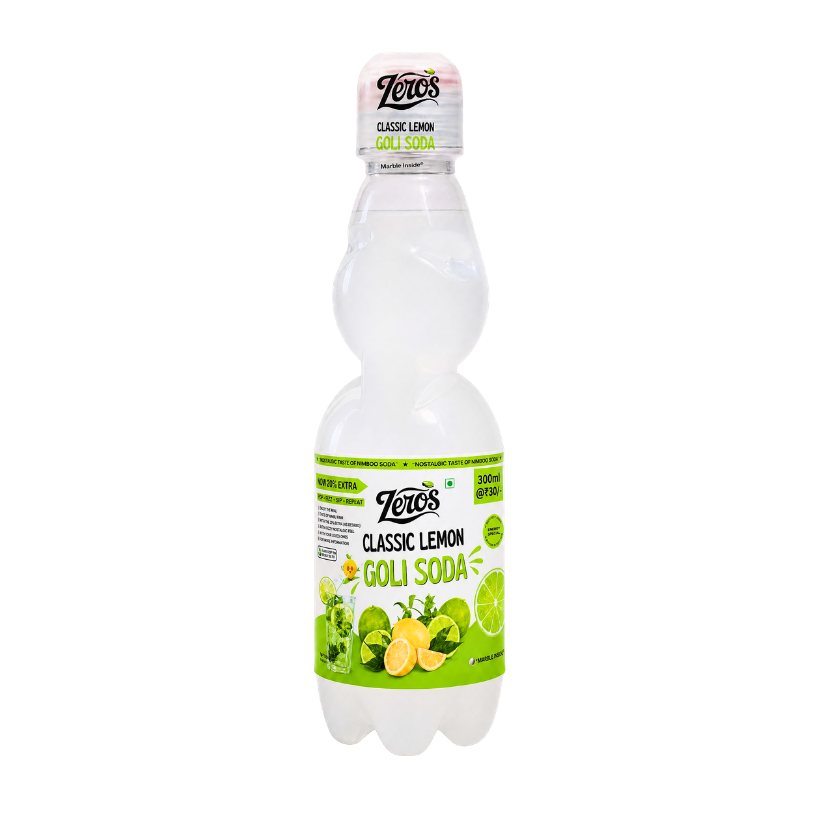
300 ml PET marble bottle
Marble soda is a carbonated soft drink in a glass bottle that has no cap. Instead, a glass marble sits in the neck, pressed upward against a rubber ring by the pressure of the carbonation inside. That pressure is the seal. Release it and the bottle opens; the marble drops into a chamber in the neck and stays there for the rest of the bottle's life.
The design is unusual because it inverts the normal relationship between a drink and its packaging. Every other fizzy bottle is a container fighting to hold gas in. This one uses the gas as the closure. The drink seals itself, which also means the bottle simply does not work with anything still — pour the fizz out and the marble falls.
It is one of the few pieces of Victorian packaging engineering still in everyday commercial use anywhere in the world, and the reason it survived has nothing to do with engineering. It survived because in two countries it stopped being a bottle and became a memory.
The bottle is filled upside down. With the liquid in and the bottle inverted, the marble falls toward the neck, and as carbon dioxide pressure builds it drives the marble hard against a rubber gasket seated in the lip. The internal pressure holds glass against the elastic ring to make the seal. Push the marble away from the ring and that seal releases.
Inside the neck, just below the mouth, the glass is moulded into two small inward dimples. These form a chamber. Once you push the marble down, those dimples catch it and hold it clear of the opening while you drink, which is what stops it rolling forward and damming the flow every time you tilt the bottle. It still happens if you tilt too fast. Most people decide this is a feature.
The same bottle, in six places, with six different sets of associations attached to it.
Goli means marble. Sold from ice buckets on street carts for over a century, most often as lemon. Also called banta in the north and gola or kancha soda in other regions.
A corruption of the English word lemonade. Introduced in the 1880s, now a festival fixture and Japan’s most exported soft drink, shipped to around forty countries.
Where the bottle was invented. Hiram Codd patented it in 1872 and it dominated British soft drinks until the crown cap displaced it in the 1930s.
The same street format as northern India, usually mixed to order with lemon and black salt.
Carried across with the South Asian street drink tradition, still sold from carts in both.
Five steps. The whole thing takes about ten seconds, and roughly everyone gets slightly wet the first time.
Every marble bottle ships with a small plastic cap that doubles as the opener. Pull it off and separate the two pieces — the pusher is the part with the raised plunger.
Hold it steady by the neck with one hand. Do not do this over a carpet, and do not do it holding the bottle in the air.
Firm and quick, straight down, one movement. The marble drops into the neck chamber and the bottle opens with a loud pop and a rush of foam.
The foam settles fast. Rushing this step is the only reason anyone ever wears their first marble soda.
The neck has two dimples that trap the marble while you drink. Tilt gently and the marble stays out of the way. Tilt sharply and it rolls back and blocks the flow — which is half the fun.
If it will not go, you are pressing at an angle. Straight down, one firm push. The marble is meant to move easily — if it needs real force, check the pusher is seated flat on the marble and not on the glass rim.
In the middle of the nineteenth century, sealing a carbonated drink was a genuinely unsolved problem. Cork was the only real option, and cork dries out. A bottle stored upright leaked its gas within days, which is why early soda bottles were often made with rounded bottoms — so they could not be stood up, so the cork stayed wet.
In 1872 Hiram Codd, an engineer from Suffolk, patented a bottle that solved it without cork at all. His design used the carbon dioxide already in the drink to hold a glass marble against a rubber washer. It was cheap, it was reusable, and it worked. Within twenty years the codd-neck bottle was the standard soft drink container across Britain and much of its empire.
Two things then happened. The crown cap arrived in 1892 — faster to apply, cheaper to make, disposable — and it had displaced the codd bottle across Britain by the 1930s. And generations of children worked out that the only way to get the marble was to smash the bottle, which is why surviving Victorian examples with the original marble intact are now collectable and most are not.
But the bottle had already travelled. It reached Japan in the 1880s, where the drink inside took its name from a mangled pronunciation of "lemonade" and became ramune. It reached India around the same time, where the marble gave it its name — goli means marble — and it became the drink of railway platforms, street carts and summer afternoons. In both countries it stopped being merely a container. That is the only reason it is still here.
Japan developed ramune into an internationally recognised packaged drink, while India's goli soda remained more strongly associated with regional bottlers and street serving.
Goli soda is now also available as a labelled, shelf-ready product from Indian producers. That makes ingredient, nutrition, batch and manufacturer information visible in a way a drink mixed to order may not provide.
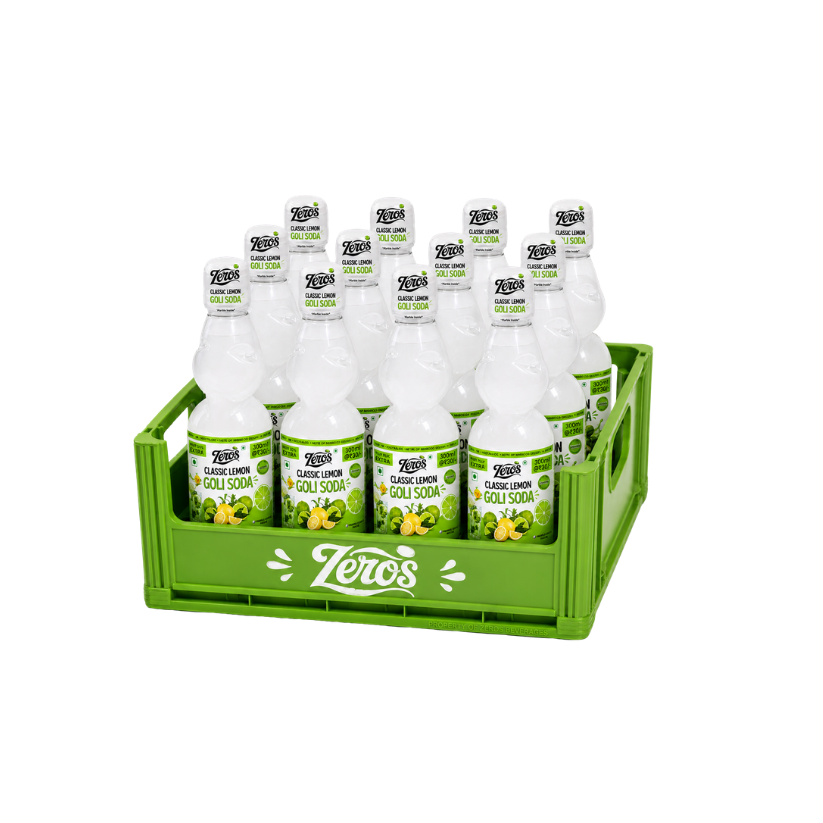
The current product should not be confused with the historic glass pack. Zeros Classic Lemon Goli Soda uses a 300 ml PET marble bottle and is made under FSSAI licence 20926012000879 at our plant in Amb, Himachal Pradesh.
Shoppers can use the official store or request a current stockist. Trade and export buyers can submit their quantity and destination for review.
Marble soda is stocked by most Indian and pan-Asian grocers, and increasingly by mainstream supermarkets in the Asian aisle. In Britain look around Southall, Wembley and Belgrave Road in Leicester; in the United States, Oak Tree Road in New Jersey and Devon Avenue in Chicago. If your local shop does not carry the Indian version, ask them — and send us the shop name.
We accept export-feasibility enquiries from importers and wholesalers evaluating United Arab Emirates, Saudi Arabia, United Kingdom, United States, Canada, Australia, Indonesia. Each market page records the current questions to verify before any pack, quantity, route or date is confirmed.
A carbonated soft drink in a glass bottle sealed by a glass marble instead of a cap. The pressure of the carbonation pushes the marble up against a rubber ring in the neck and holds it there, sealing the bottle. You open it by pushing the marble down into the bottle. It is called goli soda in India, ramune in Japan and a codd-neck bottle in Britain, where it was invented.
The bottle is filled upside down. Carbon dioxide pressure inside pushes the marble upward into a rubber gasket seated in the neck, and the marble presses against it hard enough to hold the seal. No cap, no crown, no thread. The drink seals itself with its own fizz, which is why the bottle only works with a carbonated liquid.
It is the closure. In 1872 there was no cheap, reliable way to seal a fizzy drink — corks dried out and leaked. Hiram Codd, an English engineer, worked out that the gas doing the leaking could instead do the sealing, and designed a bottle where a glass marble is held against a rubber ring by the drink’s own pressure. It was the dominant soft drink bottle in Britain for sixty years.
Structurally, yes — both are codd-neck bottles descended from the same English patent, opened the same way. The difference is culture and flavour. Ramune is Japanese, leads with a distinctive original flavour and now runs to dozens of variants. Goli soda is Indian, is almost always lemon, and is street food rather than a packaged brand. Same engineering, two separate hundred-year traditions.
The marble cannot leave the bottle during normal use. The neck is moulded with two internal dimples that trap it in a chamber below the mouth, and the mouth opening is narrower than the marble. It only comes out if the glass is deliberately broken, which is also the only way to retrieve it. As with any glass bottle, small children should be supervised.
Do not try to remove it. In a standard codd-neck bottle the marble is deliberately trapped by the shaped glass neck. Breaking a pressurised or damaged glass bottle can cause serious cuts; return or recycle the bottle intact through the available glass stream.
The format is commonly used in returnable systems where bottles are collected, inspected, washed and refilled under controlled conditions. Whether it is reused in practice depends on the producer and local return route. Consumers should not refill a commercial bottle at home.
The crown cap, patented in 1892, was faster to apply and far cheaper to produce. By the 1930s it had displaced the codd-neck almost entirely in Britain. The bottle survived where it had become cultural rather than merely functional — mainly Japan and India — which is why it is now thought of as an Asian drink despite being an English invention.
Some are. Value depends on the maker’s embossing, the colour of the glass and whether the marble is still inside — and an intact original marble matters a great deal, because most Victorian codd bottles were smashed by children who wanted the marble. Coloured glass and unusual regional makers command the most. Common clear examples are worth very little.
Tell us where you sell and what you need. The team will confirm availability, the relevant process and any applicable commercial terms before commitment.