
What is goli soda?
The Indian marble-bottle drink, explained without the folklore getting in the way: what the marble does, why the bottle stays sealed, what different regions call it, and what to check on a packaged product.
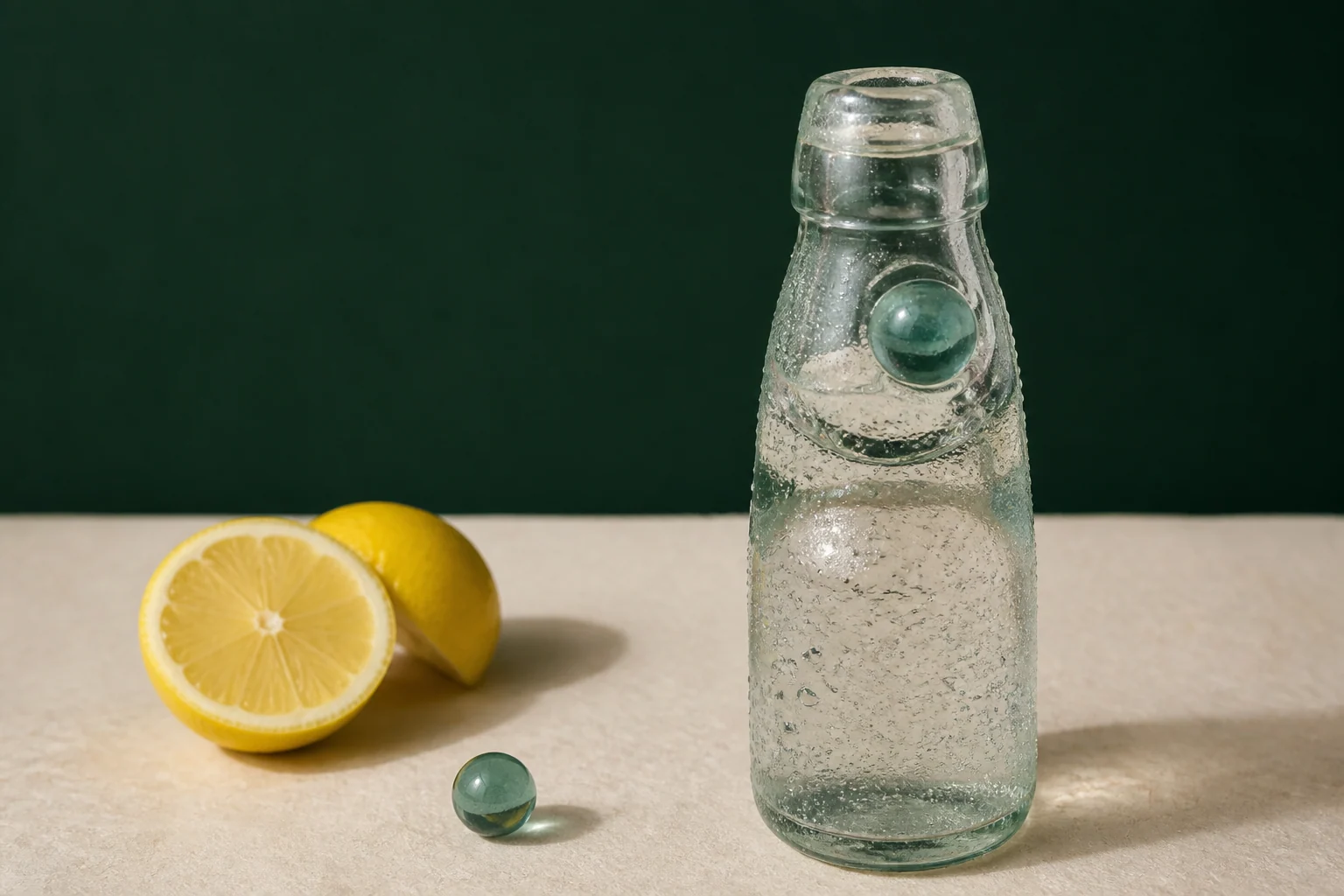
Goli soda is a carbonated drink sold in a glass Codd-neck bottle. Instead of a cap, a glass marble is pressed against a sealing ring by the drink's own gas pressure. Push the marble down and it drops into a chamber in the neck, opening the bottle with its familiar pop.
The marble is the bottle cap
The marble is not decoration and it is not added after the bottle is closed. It is the stopper. In a sealed bottle, internal pressure holds the marble against an elastic ring in the neck. When a pusher moves the marble away from that ring, the seal breaks and the marble stays trapped below the mouth by the bottle's shaped neck.
Hiram Codd's 1872 patent describes this ball-stopper system for aerated liquids. The bottle later became part of everyday drink culture in India, where the marble gave it the name goli.
What India calls it
The names overlap; they are not separate legal product categories. A buyer should use the bottle, label and ingredient declaration—not the regional nickname—to understand what is being sold.
| Name | How it is commonly used |
|---|---|
| Goli soda | Common across India; goli refers to the marble in the neck. |
| Banta soda | Widely used in Delhi and other parts of north India. |
| Kancha or kanche wali bottle | A descriptive name based on the glass marble. |
| Marble soda | The plain-English packaging term used by many buyers and importers. |
| Codd-neck bottle | The historic bottle-design name, after inventor Hiram Codd. |
Goli soda and ordinary PET soda
| Feature | Goli soda | Typical PET soda |
|---|---|---|
| Closure | Marble and sealing ring | Screw cap |
| Pack | Shaped glass bottle | Plastic bottle |
| Opening | Marble is pushed into the neck chamber | Cap is twisted off |
| Return system | Often managed as returnable glass in trade | Depends on the local collection system |
These are packaging differences, not automatic claims about taste, safety, nutrition or environmental impact. Those depend on the actual drink, producer, route and return system.
What is in Zeros Classic Lemon
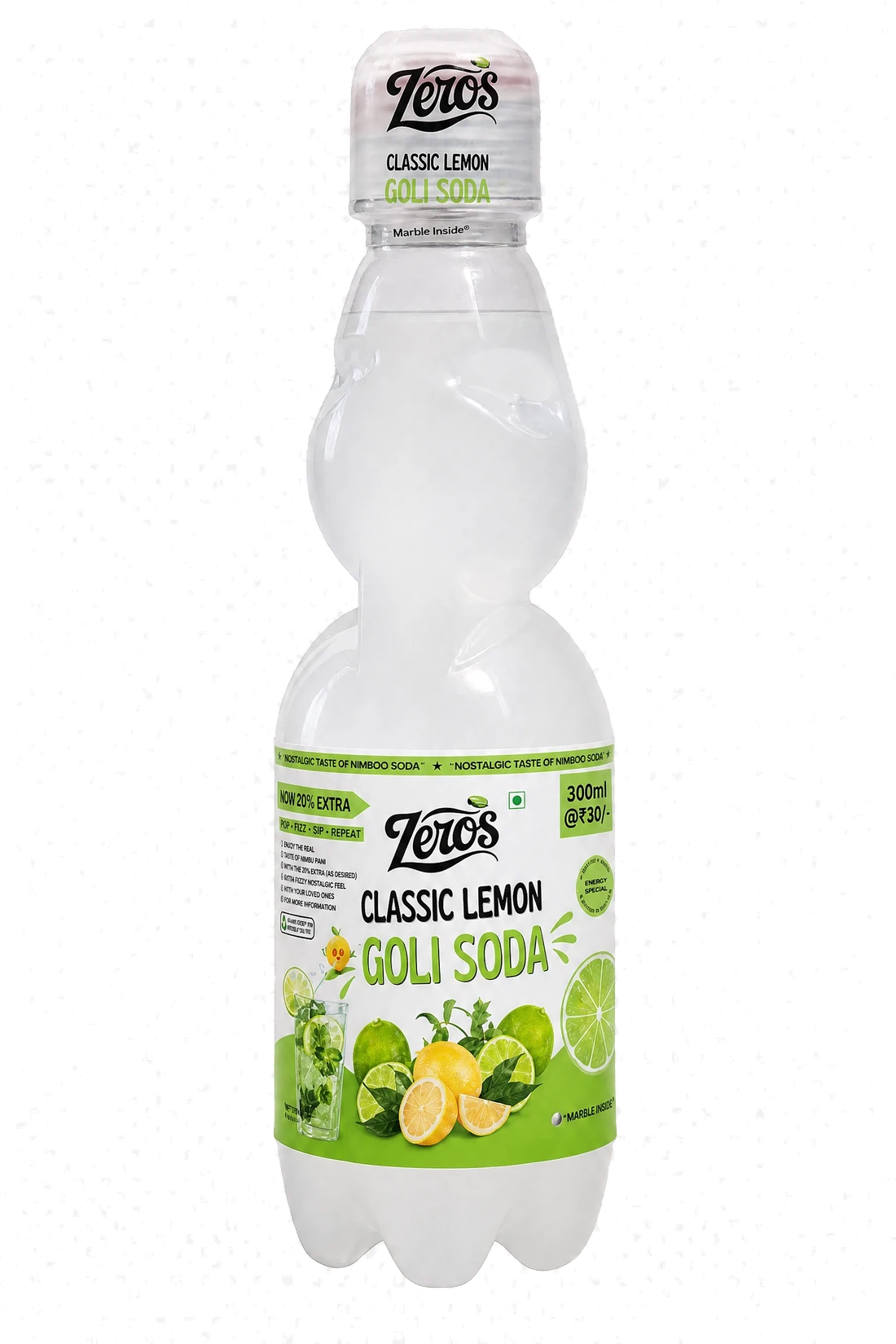
The current Zeros label declares a 300 ml serving with 83 kcal and 19.3 g total sugar. The ingredient declaration is: Mineral water, sugar, carbon dioxide, nature identical flavouring substances (lemon), salt, emulsifying and stabilizing agent (INS 331, INS 414), acidity regulator (INS 296), permitted synthetic food colour (INS 102), permitted class II preservative (E211).
That is specific to Zeros Classic Lemon Goli Soda. It should not be used as a general ingredient or nutrition statement for every banta or goli soda sold elsewhere.
How to open it safely
- Chill the bottle and keep it upright on a firm, flat surface.
- Place the supplied pusher flat over the marble and press straight down.
- Wait a few seconds for the initial foam to settle before lifting the bottle.
- Never strike the glass, pry at the neck or break the bottle to remove the marble.
For the illustrated opening sequence, see the Zeros product page or the deeper marble bottle guide.
Goli soda questions
What is goli soda?
Goli soda is a carbonated drink in a reusable glass bottle sealed by a marble. Carbonation pressure holds the marble against a sealing ring. The drink opens when the marble is pushed down into the neck chamber.
Is goli soda the same as banta soda?
They usually describe the same marble-bottle format. Banta is especially common in Delhi and north India, while goli soda is understood more broadly. Recipes and serving styles can differ by seller.
Why does the bottle have a marble?
The marble is the closure. Pressure from the carbonated drink pushes it against an elastic ring inside the neck to make the seal.
How do you open a goli soda bottle safely?
Stand the bottle upright on a firm surface, use the supplied pusher, press straight down, and wait briefly for the foam to settle. Do not strike the glass or try to remove the marble.
Sources and scope
- Hiram Codd, US Patent 129,652 (1872) — the ball-stopper bottle mechanism.
- The UK National Archives: Rylands and Codd — historical context for the Codd-neck bottle.
- Zeros ingredient, nutrition, pack and licence facts are taken from the current product label published on this site.
Let us bring the classic to more places
Territories across north India are being allotted right now. Tell us where you sell and we will come back with pricing, margins and the current position in your area.